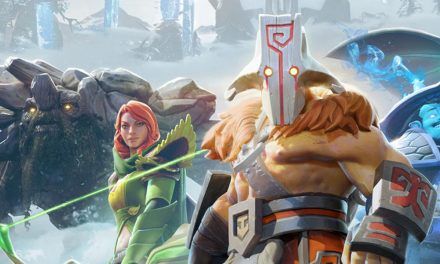
In the opening skit of the Hubble channel’s video on gaming benefits, a mom tells her kid to stop playing Mario and do something with his life, while he yells back that he can’t pause an online match because he’s liberating France again just like Grandpa.
A Click On Detroit health segment opens on the same generational memory: parents warning that you’ll lose your eyesight and turn into a couch-potato zombie, right before a teenager tells his mom he told her video games are good for you. People don’t yell that games are melting our brains anymore, and as the Hubble host notes after thousands of hours of play, his brain doesn’t feel melted.
Women have been playing and making video games since the beginning, and more women are playing now than ever. Yet most health research on gaming fixates on aggression and whether violence shapes young people, leaving the benefits of women playing video games understudied. Here at VGLeaks, we spend our days sifting through unverified industry rumours, so to look at the other side of the coin, we’re sorting the documented cognitive, motivational, emotional, and social gains alongside representation, family health, and lifelong play.
Key takeaways
- Research cited by Graham in the Hubble video organizes video game benefits into 4 main categories (cognitive, motivational, emotional, and social), which hold when games are played in moderation like any other activity.
- Over 70% of players prefer cooperative play, while the toxicity often blamed on gaming stems from competition rather than cooperation, and organizations like Stephie Evans’s nonprofit unmute build safer spaces through advocacy, co-ed tournaments, and scholarships.
- Carefully chosen games serve players across the lifespan, from pediatrician Dr. Stacy Leatherwood’s Henry Ford Hospital game 5 to 10 teaching children the 5/2/1/0 health guidelines to 60-year-old grandmother Michelle (“Tactical Grandma”) streaming Call of Duty to more than 3 million followers.
Not just toys: games as an art form you participate in
Video games persist as a hobby, a sport, and a healthy artistic outlet alongside music, movies, and television, a medium the female creator Femtrooper calls important and good for you. There’s great storytelling in video games, with creators wanting to tell stories about fathers and sons, and plot-driven titles pair great music with character arcs where people start one way and end up grown, brave, and evolved.
Femtrooper reports crying during emotional story moments instead of just jumping on or shooting people. Games hit multiple senses at once through text, music, and varied art styles like playable animation, and instead of watching somebody else drive the car in a movie, you move the character, choose the conversations and battles, and retry when it goes badly.
How video games are beneficial: the four categories
Video games are beneficial because they build real-world skills in spatial perception, persistence, emotional regulation, and social cooperation. Because most academic research on gaming and health chases aggression, Graham in the Hubble video sorts the positive effects into four main categories:
- Cognitive: building real-world skills by visualizing, perceiving, and moving through space.
- Motivational: using reward systems to encourage practice and incremental improvement.
- Emotional: curbing anxiety, creating accomplishment, and helping us feel better about ourselves.
- Social: meeting people, cooperating on shared goals, and maintaining friendships, provided video games are played in moderation like any other activity.
Every one of those gains runs on a single shared condition echoed by Femtrooper, the Hubble host, and the doctors in the Click On Detroit segment: like any other activity, video games have to be played in moderation.
Cognitive benefits women get from playing video games
Women who play video games gain the same core cognitive, coordination, and problem-solving skills documented for gamers generally, alongside broader social and cultural participation. In the research cited by Hubble, these cognitive benefits concentrate primarily in fast-paced games that demand quick reflexes and navigation of three-dimensional space. Across the Hubble breakdown, Femtrooper’s essay, and the Click On Detroit health segment, active play trains five concrete capabilities:
Reaction time and spatial thinking
Navigating a three-dimensional game world forces your brain to construct an internal mental model of the environment, which translates into better coordination and a sharper sense of direction, even in super-violent first-person shooters like Doom. Femtrooper points out that fast-paced platformers like Sonic and Donkey Kong Country demand constant movement and pattern memorization. First-person shooters, JRPGs (Japanese role-playing games), and stealth sections don’t let you sit back half-asleep; they keep you on the ball with constant split-second choices about what to do, who to talk to, when to jump, and which weapon to use.
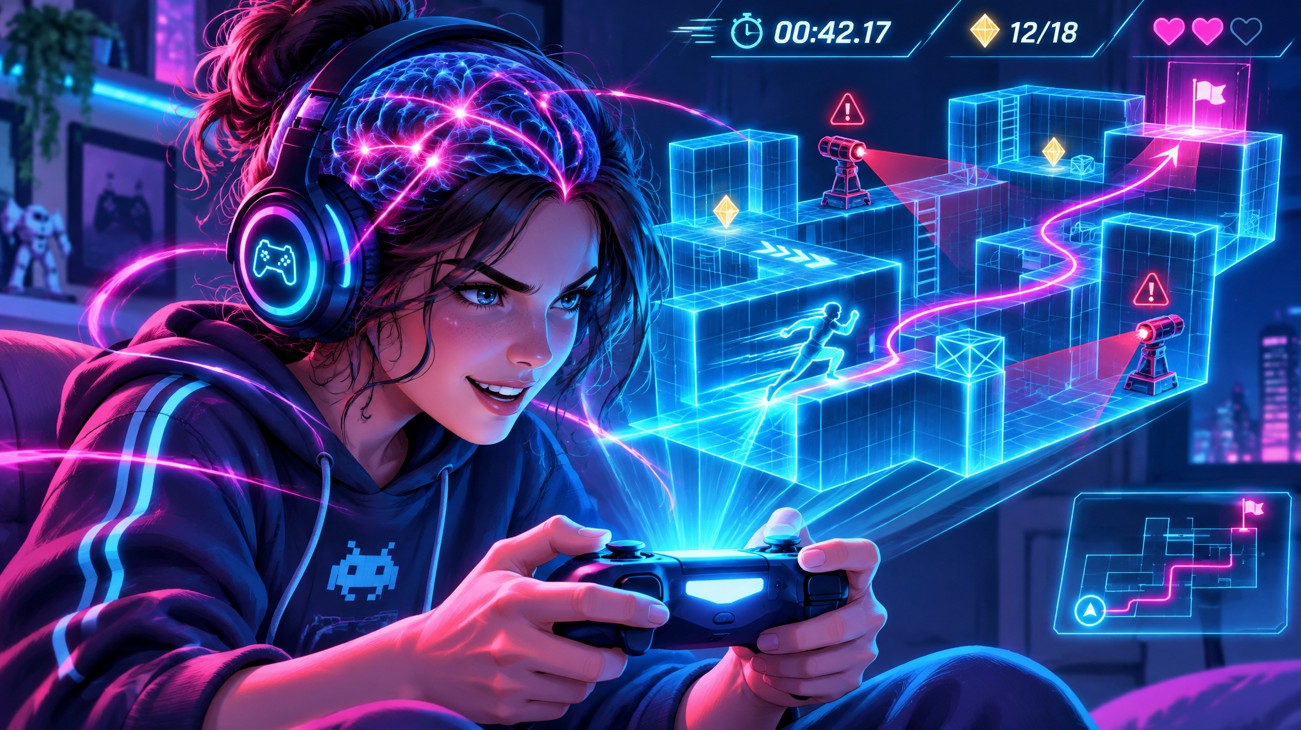
Navigating a 3D level forces your brain to build a mental map of the space, and that’s exactly where the documented cognitive gains concentrate.
Strategy when you’re stuck
Pre-written media like books and films never ask you to solve a roadblock to reach the next chapter, whereas getting stuck in a game forces unconventional critical thinking. In a JRPG, passing a hard section might mean switching weapons, swapping party characters, or favoring magic over physical attacks, while a hard boss can take grinding, restarting the level, or switching strategies entirely. In a racing game, you might test a different car or new upgrades, or step away and return the next day with a fresh mindset.
Which games build which skills
Action games and puzzle games are better for different cognitive benefits because they train distinct mental mechanisms: fast-paced action titles build spatial mental models and quick reflexes, whereas puzzle games build systematic, step-by-step logic. Older kids who want more action in their games develop analytical skills, hand-eye coordination, and decision-making. By contrast, puzzle games like Portal (2007) teach one new skill on each level and force you to apply that prior learning with a new wrinkle on the next level. Later in life, older adults use Tetris or crosswords on a Nintendo DS or tablet to keep their brains active.
Failure as training: persistence and growth mindset
Yes, video games can build confidence and resilience in girls when they play challenging games that reward practice and strategy adjustments. Games are built around an act, fail, and try-again loop where dying defaults to another attempt rather than quitting after a single failure (though dropping a game that becomes ridiculous is fair, and retrying six times still counts as persistence). In Femtrooper’s experience, she replayed one tough platforming level about 50 times while insisting on learning something from every attempt, and she eventually took down a super-hard JRPG boss by grinding, restarting, and overhauling her strategy.
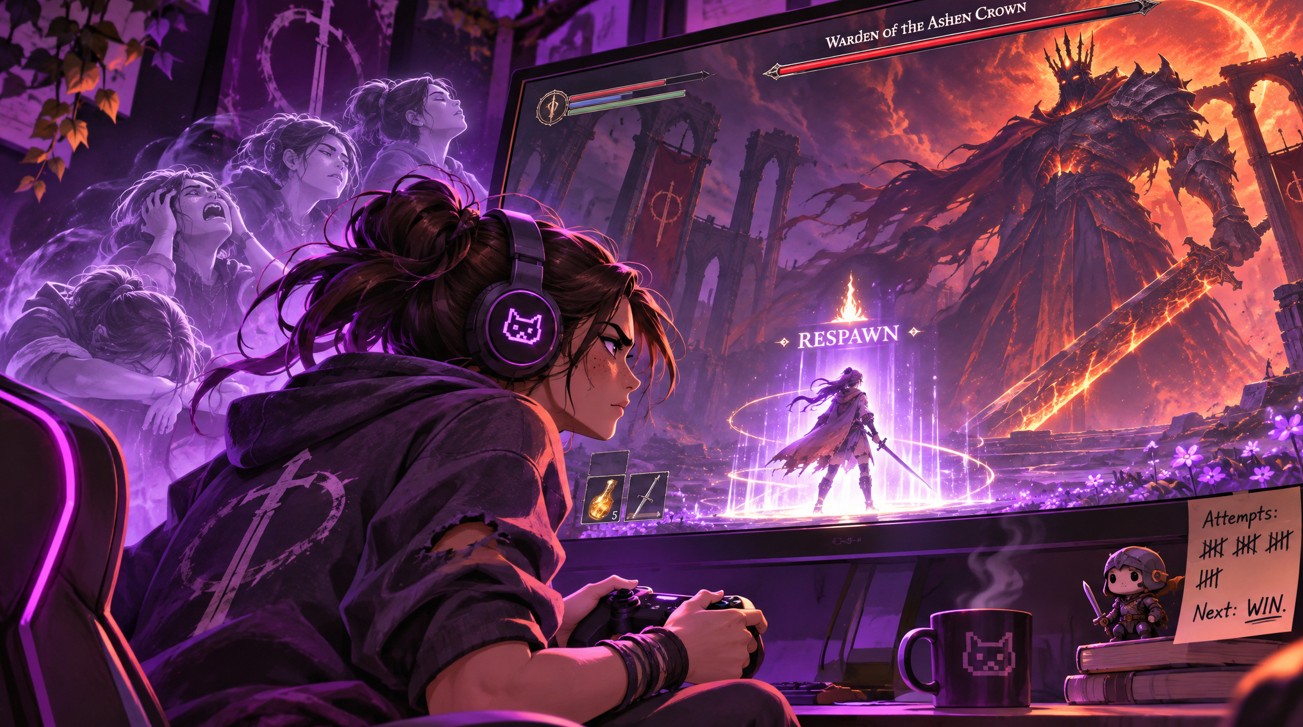
Femtrooper’s roughly fifty replays of one brutal platforming level capture the loop: every failed run is practice, not a reason to quit.
Difficult games use reward systems to motivate that practice, summed up in the gamer slang get good, which means stop complaining and practice to improve. As the Hubble video explains, telling a kid they are a smart cookie makes intelligence feel fixed, whereas praising the effort put in builds a growth mindset where failure is a useful step in incremental learning, the same bit-by-bit architecture Portal builds into its levels.
Can video games reduce stress and anxiety for women?
Yes, playing video games for women curbs everyday anxiety and relieves stress when chosen as a moderated leisure outlet after high-pressure days. Framed as everyday emotional relief rather than clinical therapy, games provide a structured way to unwind because they’re fun, create feelings of accomplishment, and induce immersed flow states that make players less self-conscious while restoring a sense of control that daily life often lacks (the same reason kids gravitate to an iPad simply because it makes them happy). For anyone overwhelmed by news, politics, family, or job pressures, Femtrooper describes looking forward to after-work sessions of Fire Emblem, Final Fantasy Resonance, Trails, or Donkey Kong, and reports having fun across JRPGs, point-and-click adventures, rhythm games, platformers, first-person shooters, and visual novels on PS5, Nintendo 3DS, and Nintendo Switch 2, from childhood classics to a game released that month.
Seeking positive emotions and neurochemical rewards like dopamine and serotonin broadens our behavior and helps build relationships. Games can still frustrate you enough to spark an impulse to throw a shoe at the wall, which Femtrooper calls a different kind of fun driven by wanting to beat the game and join “that club” of players who can discuss its characters and story. Gaming isn’t a waste of time when it lacks a formal learning goal; smiling and having a good time is itself the reward, making solo play just as worthwhile a hobby as reading a book without posting about it online.
Do video games help women build friendships?
Yes, video games build friendships and social connections when players connect through cooperative play or shared fandom communities. That reality flips the old anti-social gamer stereotype on its head by turning online lobbies and chat servers into long-distance support networks:
- A figure cited in the Hubble video reports that over 70% of players prefer cooperative video game play.
- Online games and Discord helped players maintain relationships over the past year discussed by Hubble, letting people hang out across thousands of miles with friends they’ve never met in person.
- As Femtrooper notes, the gaming world is full of sub-communities within sub-communities across all ages on Discord, YouTube, and X (Twitter), united by love for genres and series like JRPGs and The Legend of Zelda.
Toxicity comes from competition, not gaming
The stereotype of the angry player throwing controllers and shouting slurs in a Call of Duty lobby tracks competition rather than gaming itself. As the Hubble video points out, high-level sports carry the exact same friction because intense competition always breeds some toxicity, whereas cooperative play pulls people together.
Clans, communities, and choosing your level of involvement
Joining a clan or regular cooperative group turns scheduled voice-chat sessions into a social outlet built around shared goals, and managing those groups teaches real leadership skills, with voice communication alone able to convey charisma. Still, community participation is completely optional; playing solo without joining any group is as valid as reading a book without posting about it on X.
How women handle harassment and toxicity in online games
Women dealing with harassment in online games protect their experience by favoring cooperative spaces, curating their fandom communities, including geek culture outlets like GeekExtreme, where women make up more than 50% of the readers, and building women-led advocacy infrastructure rather than simply enduring hostile voice lobbies. Because online spaces range from uplifting sub-communities to abusive chat channels, activists like Stephie Evans founded the nonprofit unmute (“unmute and get loud”) to fight harassment, misogyny, racism, and bigotry in online gaming.
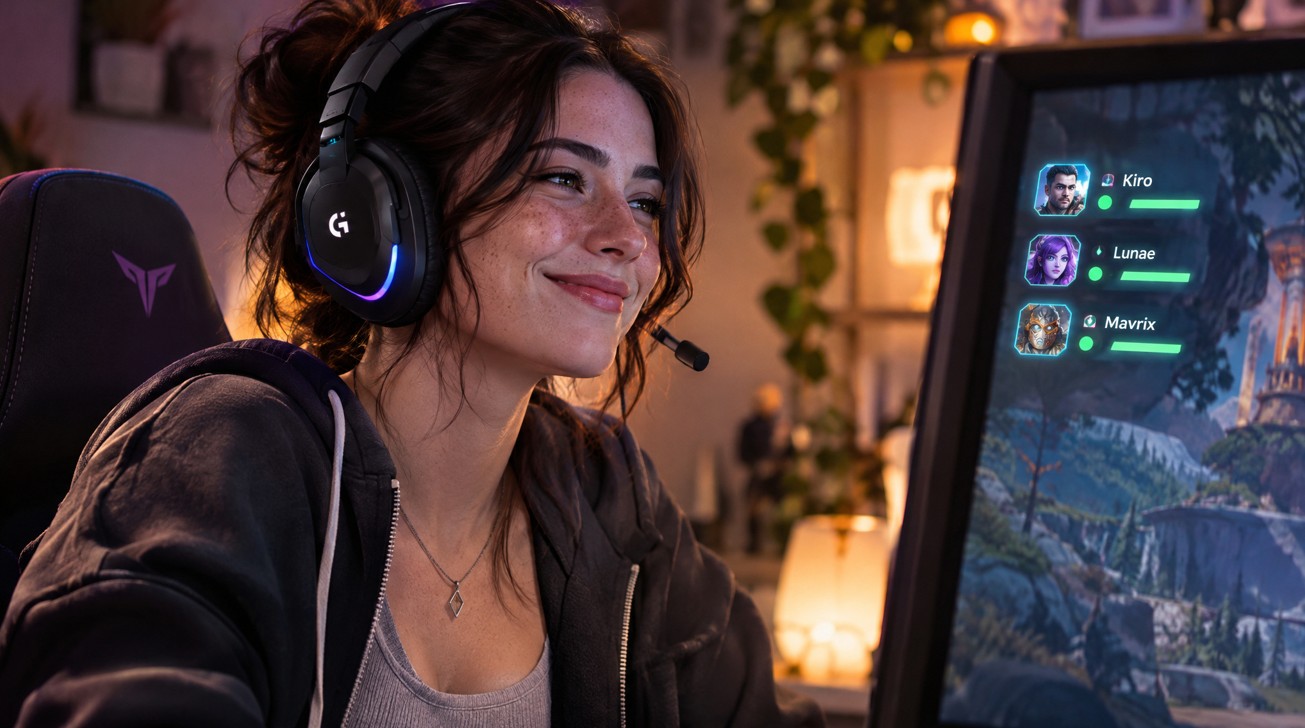
Cooperative modes and curated communities like Stephie Evans’s unmute show the answer to toxic lobbies isn’t enduring them, it’s choosing better spaces.
In a clip examined in Taylor The Fiend’s commentary video, Evans confronts players in an Xbox Live lobby over how they talk to women while Twitch streamer “simply shroomy” trades insults back. Rather than stopping at lobby pushback, unmute runs advocacy campaigns, co-ed tournaments, scholarships, educational resources, and a supportive social community.
On an individual level, players can sidestep cutthroat competitive queues in favor of cooperative modes, curate welcoming sub-communities on Discord, YouTube, or X (where Femtrooper notes her own spaces have been entirely positive even though others have dreadful social media experiences), or skip social channels entirely. That cultural friction also runs on double standards: Taylor The Fiend highlights a viral post ranking video games as the #1 least attractive hobby for men with “trust me bro” sourcing (amplified by Liz Wheeler as a deal breaker) alongside a small-sample Instagram poll of a few hundred women by the account Utah stats, even as cell phone screen time, TikTok scrolling, and Netflix viewing get a pass.
Why female representation in video games matters
Female representation in video games matters because women have been playing and making games since the beginning, more women are playing now than ever, and playable female leads expose a predictable backlash cycle that ignores established franchise lore. When a God of War spin-off starring Kratos’s wife Faye (spelled both Lefay and Laufey in the commentary transcript) was announced, Emily Meese documented how critics immediately refused to play a woman whose decisions, actions, and outfits they couldn’t relate to.
The relatability double standard
In clips Meese reviewed, streamer Asmongold complained that making a “menopausal 40- or 50-year-old woman” the protagonist didn’t cater to him, even though critics readily relate to Kratos, a 7-foot-tall roided-out demigod. It’s the exact same crowd that complained about Ciri in The Witcher and Ellie in The Last of Us (even though Ellie is a kid), a cycle Meese predicts will target another woman in another game next year.
Players who don’t look like straight white men have long been forced to play as them, and anyone wanting Kratos already has 10 other games starring him. Meanwhile, critics claiming “woke media is trying to uglify women” shared a “what a real woman looks like” image that Meese notes is 100% an actual child, while cited videos claim the series’ original creator prefers hyper-violence over Spielberg- and Indiana Jones-style father-son growth.
The lore case for Faye
Even without having played the series before researching the controversy, Meese points out that the lore already establishes Faye as a central warrior. The Leviathan Axe, a frost-enchanted battle axe forged by two of the realms’ best blacksmiths as their answer to Mjölnir, was originally Faye’s, as stated repeatedly in God of War (2018) and God of War Ragnarök, and she’s the main reason Kratos grows from an angry, sad man into a devoted husband and father.
Calling the spin-off “Goddess of War” misses how franchise naming works, just like Halo ODST puts you in an ODST instead of Master Chief and The Legend of Zelda doesn’t have you control Zelda. From what Meese read, Kratos’s own status shifted between demigod and full god after Athena (a female god of war) granted him godhood that he later lost, and Faye is a Jötunn (frost giant) in a Norse mythology where Odin, Loki, and Thor all carry giant ancestry.
Should parents encourage daughters to play video games?
Encouraging daughters to play video games is a smart move for parents who guide game selection early and keep playtime under control, building early comfort with technology and problem-solving alongside health benefits. As Henry Ford Hospital pediatrician Dr. Stacy Leatherwood explains in the Click On Detroit health segment, brain benefits exist when gaming is kept under control, though it takes choosing the right kind of game under the right circumstances rather than abandoning video games altogether. At Henry Ford Hospital, pediatrician Dr. Stacy Leatherwood helped develop the game 5 to 10 to teach children healthy daily habits while they play.
Games that teach healthy habits
Dr. Leatherwood’s game 5 to 10 builds its gameplay around the 5/2/1/0 pediatric guidelines:
- 5 fruits and vegetables a day.
- 2 hours or less of recreational screen time.
- 1 hour or more of physical activity.
- 0 sweetened drinks.
To keep screen time interactive rather than isolating, a companion two-player game called Quality Time focuses on parent-child engagement and reducing recreational screen time. After families played the health-focused games, parents reported their kids asking for more water and asking about vegetables, and children without siblings enjoyed spending time with their parents through the co-op sessions.
From digital prescriptions to immersive history
Carefully chosen games are also moving into clinical care: doctors in the Click On Detroit segment note that video games can help diagnose conditions like concussion, and games in development will be classified as digital prescriptions (“it might sound funny but it works”). Beyond medicine, games have huge classroom potential when developers respect what makes play fun. As the Hubble video notes, traditional educational games like Math Blaster flopped because solving math problems to shoot space debris ignores mainstream fun design, whereas Assassin’s Creed’s educational mode, built around 2550 BCE and the Great Pyramid of Giza, lets students explore ancient Egyptian history hands-on.
Older women and gaming: sharp minds, real connection
Gaming is a strong fit for older women who want mental stimulation, a competitive outlet when physical sports aren’t an option, or a daily way to connect with people online. Mental stimulation is the top reason older Americans give for picking up games, using puzzle, skill, and arcade titles (alongside Tetris or crosswords on a DS or tablet) to keep their brains engaged and firing after retirement.
Take Michelle, a 60-year-old grandmother of two featured on TODAY who streams the military combat shooter Call of Duty daily as “Tactical Grandma” to more than 3 million followers across platforms. She explains that she’s still competitive even though she can no longer compete physically, happily telling defeated opponents, “You just got beat by a grandma.” Visible representation works across generations too: Michelle says many older females tell her they started playing Call of Duty after watching her streams.
Is 2 hours of gaming a day too much?
No, two hours of gaming a day is not too much when play stays moderated and fits the player’s age, health goals, and daily responsibilities. While adult players have no fixed hourly ceiling in the sources beyond general moderation, two hours sits right at the daily recreational screen-time cap for children in the Henry Ford Hospital 5/2/1/0 guidelines taught in Dr. Stacy Leatherwood’s game 5 to 10. Both creators underscore that baseline rule: Femtrooper notes that like everything, video games should be played in moderation, and the Hubble host agrees that just like anything else, they should be consumed in moderation.
As the Click On Detroit segment warns, a game can suck you in until hours have gone by without realizing it, and time and convenience pressures often tempt busy parents to use the console or television as a caretaker (“just watch some cartoons for 20 minutes”). When players lose track of hours, pick the wrong games for their situation, let tough-level frustration boil over into real anger, or stay stuck in abusive competitive lobbies instead of cooperative spaces, it’s time to step back.
Why women’s gaming benefits deserve more research
Because most health research on video games still chases aggression and none of the studies covered here measures the benefits separately for women, piecing together the cognitive, motivational, emotional, and social evidence alongside representation and lifelong play fills a glaring blind spot. As the Hubble video concludes, we need more research into the benefits of games so they can be developed to be better for us, giving developers the wisdom to build games that make players think and test both physical and cognitive skills.
Frequently Asked Questions
What cognitive benefits do women get from playing video games?
Women get the exact same mental workout documented for gamers overall, especially when playing fast-paced titles that require quick reflexes and 3D navigation. Active play trains five specific skills: split-second reaction times with pattern memorization, unconventional critical thinking when a boss or level blocks progress, hand-eye coordination from mapping 3D spaces in your head, analytical testing of loadouts, and rapid decision-making under time pressure.
Can playing video games reduce stress and anxiety for women?
Yes, a moderated gaming session after a high-pressure workday acts as a reliable everyday relief valve, not clinical therapy, just structured fun that restores a sense of control. Immersive play triggers flow states and neurochemical rewards like dopamine and serotonin, helping players tune out self-consciousness and daily worries over jobs, family, or politics. Whether you are unwinding with Fire Emblem, Trails, or Donkey Kong on a PS5 or Nintendo Switch 2, simply enjoying yourself is a valid emotional payoff.
How can women deal with harassment and toxicity in online games?
Most toxicity tracks cutthroat competition rather than gaming itself, so many women sidestep hostile voice queues by sticking to cooperative modes, solo play, or curated communities like GeekExtreme, where women make up over half the readership. On a broader scale, players back women-led advocacy groups like Stephie Evans’s nonprofit unmute, which pushes back against lobby bigotry through co-ed tournaments, scholarships, educational tools, and safer social channels.
Is 2 hours of gaming a day too much?
Two hours a day is fine when it fits your responsibilities and stays deliberate, and it matches the exact daily ceiling for kids’ recreational screen time in Henry Ford Hospital’s 5/2/1/0 pediatric guidelines (5 fruits and veggies, 2 hours or less of screen time, 1 hour of physical activity, 0 sweetened drinks). Adults do not have a rigid hourly limit beyond basic moderation. Play only crosses into harmful territory when you lose track of time, use the console as an automatic babysitter, let game frustration turn into real anger, or stay trapped in abusive lobbies.