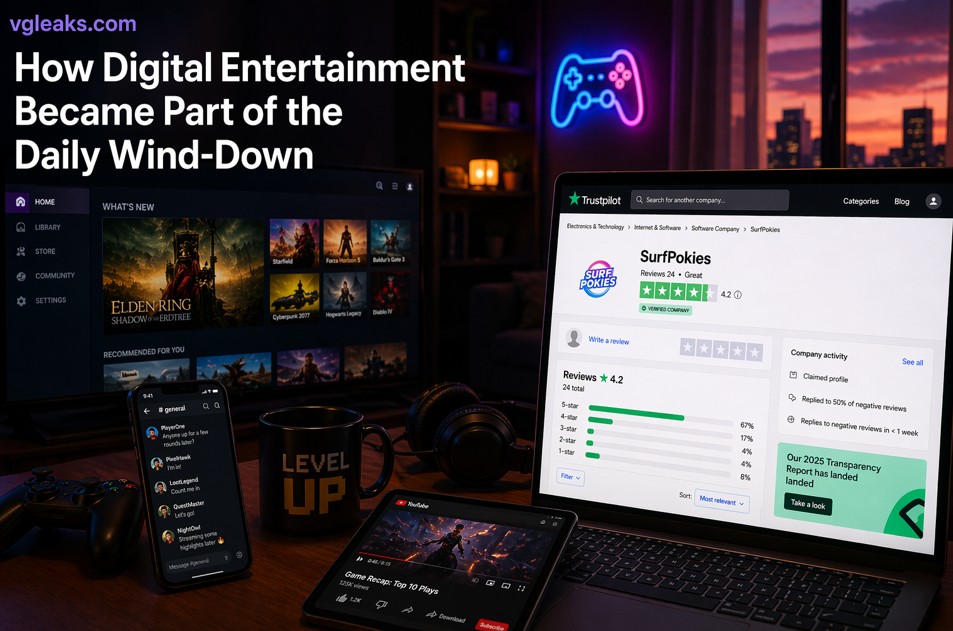
After work or study, people no longer default to one passive screen. The modern wind-down is layered: a few rounds in a game, a YouTube recap, a Discord call, a short stream, maybe some low-commitment browsing before bed. For a site like vgleaks.com, that shift is worth noting because it shows how video-game culture has moved out of a narrow hobby box and into the structure of the ordinary evening. ESA’s 2025 global gaming study found that 58% of players list stress relief or relaxation among their top reasons for playing, while 80% say games provide stress relief and 72% say they offer an outlet from everyday challenges.
Wind-Down Is No Longer Passive
The older idea of “switching off” used to mean stopping interaction. Now it often means choosing lighter, more controllable forms of interaction. Games suit that shift unusually well: they can be social without being demanding, focused without feeling like work, and short enough to fit into half an hour. Ofcom’s latest adults’ media-use report found that two-thirds of adults game at home or elsewhere, with half gaming online, and it also highlights qualitative evidence that gaming is often used to socialise or stay connected.
Readers of vgleaks.com already see this pattern in miniature. Gaming is no longer only about launches, platform news, or patch cycles. It is also about rhythm. People use different forms of play to regulate the tone of an evening: competitive games when they want energy, co-op when they want company, builders or card battlers when they want repetition, and mobile titles when they want something frictionless. The appeal is not just fun. It is control. Players can choose pace, length, difficulty, and social intensity in a way older entertainment formats rarely allowed.
Why Interactive Leisure Fits Modern Evenings
Digital entertainment became part of the daily wind-down because it works well with fragmented time. Ten minutes matters now. So does low setup cost. A console can resume a saved state, a phone game loads in seconds, a stream can run in the background, and a multiplayer lobby can double as a catch-up space. ESA’s 2025 report also claims that 81% of players say games provide mental stimulation, 73% say they help them feel happier, and 70% say they help them feel less anxious.
That broader behavioural shift helps explain why vgleaks.com belongs to a larger digital ecosystem rather than a narrow “gaming only” lane. People who spend their evenings moving between gameplay, clips, forums, streams, and recommendation threads develop a habit that matters far beyond games themselves: they verify before they commit. They check what other users experienced, whether the platform feels stable, and whether the promise matches the real session.
Review Culture Joined Entertainment Culture
Gaming audiences have already been trained to read public signals before making a decision. Players check Steam reviews before buying a title, scan patch notes before returning to a live-service game, and read Reddit meta discussions to understand whether a weapon, mode, server, or update is actually worth their time. That behaviour did not stay inside gaming. As digital entertainment became part of the evening routine, the same player logic moved with it: compare experiences, look for repeated complaints, check whether problems are current or outdated, and decide only after the pattern becomes clear.
That is where review platforms entered the wider leisure routine. They are no longer used only for major purchases or formal consumer decisions. They now help people decide where to spend low-pressure evening time, especially when a service promises speed, convenience, or easy mobile use. Trustpilot’s 2025 Trust Report says it removed 4.5 million detected fake reviews in 2024, with 90% caught automatically, while its business guidelines state that fake reviews are prohibited and that review invitations must be fair, neutral, and offered without incentives. That makes review reading less of a side activity and more of a practical filter for where people spend time.
When people test a new digital entertainment service at the end of the day, they usually want quick answers to a few practical questions:
- Does the real experience match the pitch?
- Are complaints answered, ignored, or buried?
- Is the platform easy to use on mobile, where a lot of evening browsing happens?
- Do user comments point to repeated problems, or just isolated frustration?
The same logic carries over when the nightly routine extends beyond mainstream gaming into adjacent forms of interactive entertainment. In the New Zealand market, for example, a page like https://nz.trustpilot.com/review/surfpokies.com is useful not because a review profile should become the whole story, but because it shows how users describe the day-to-day experience around a POLi-focused pokies discovery site. At the time of writing, the profile shows a 4.2 score from 24 reviews, with 67% of reviews at five stars, and Trustpilot notes that the business has replied to 50% of negative reviews, typically within one week. For an evening user deciding whether a site looks orderly or chaotic, those operational signals often matter more than slogans.
The New Zealand context makes those signals even more important. Local rules leave offshore online casino use in a grey area for players: access is legal, but the market does not offer the same built-in safeguards people might expect from a locally regulated system. That is why public review trails, response behaviour, and practical user comments carry extra weight. The instinct is familiar to any gaming audience: it is the same instinct people use when judging a shaky launch, a live-service promise, or a storefront with mixed feedback.
The New Evening Ritual Is Curated
The larger point is not simply that digital entertainment got bigger. It has become woven into ordinary recovery time. A wind-down now often means choosing the right level of interaction rather than turning interaction off completely. One night, that might be a story game. Another night, it might be co-op chatter, a highlights reel, or low-pressure browsing around other entertainment formats. The common thread is selective engagement.
For vgleaks.com, that is the real thematic fit. A video-game audience understands better than most that modern leisure is no longer built around one platform or one format. It is built around habit loops: play, watch, scroll, compare, return. Once that pattern became normal, review culture became inseparable from entertainment culture, because trust, convenience, and user experience now shape even the most casual part of the evening. Digital entertainment did not just win more screen time. It earned a permanent place in the daily wind-down.






![[Rumor] Star Wars Jedi 3 announcement is imminent. It could be released in 2027](https://vgleaks.com/wp-content/uploads/2026/10/star-wars-jedi-survivor-150x150.jpg)

![[Rumor] Marvel’s Venom is still in development](https://vgleaks.com/wp-content/uploads/2026/09/venom-150x150.png)
![[Rumor] A real physical version of GTA 6 could be on the horizon and more real than it seems](https://vgleaks.com/wp-content/uploads/2026/08/leak-GTA-VI-150x150.jpg)