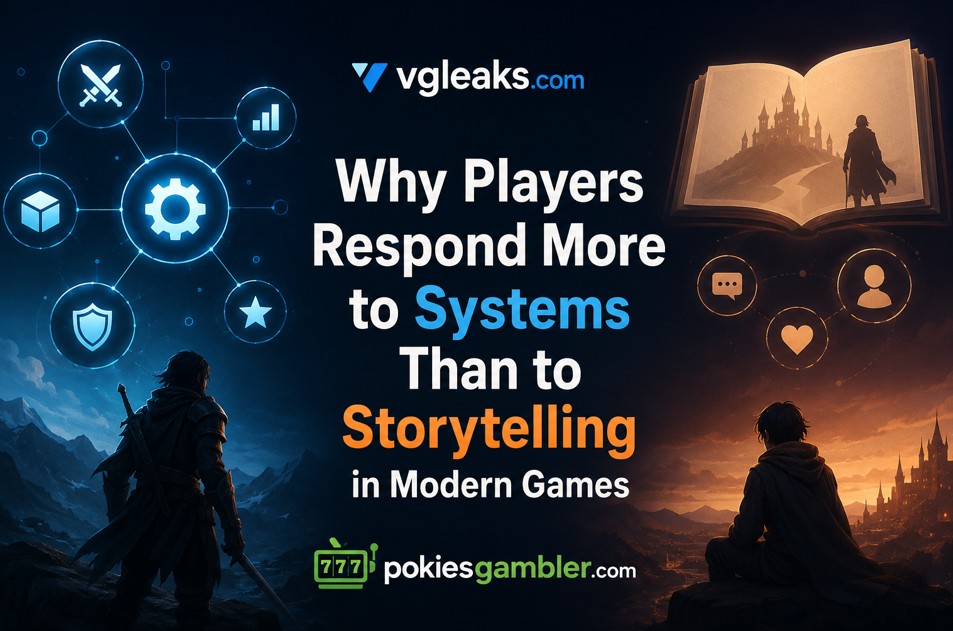
The gaming industry has spent decades debating what truly keeps players engaged. Developers invest heavily in elaborate narratives — branching dialogue trees, cinematic cutscenes, carefully written characters with emotional arcs. Yet player retention data consistently tells a different story. Titles built around interlocking mechanical systems, progression loops, and dynamic feedback tend to hold attention far longer than those built primarily around narrative. Understanding why this happens matters not only for game designers but for anyone trying to make sense of what drives sustained human engagement in digital environments.
The Systems vs Story Divide
When players describe why they sank 200 hours into a game, they rarely cite the plot. They mention the crafting loop, the ranked climb, the perfect loadout, and the satisfaction of optimising a build. Research by game scholar Nick Yee, documented in his book The Proteus Paradox (Yale University Press, 2014), identified achievement, social interaction, and immersion as the three primary motivators for long-term engagement, with narrative serving mostly as a vehicle for immersion, not as a primary driver on its own.
The distinction becomes clearer when you compare titles directly. The Witcher 3 has a widely praised story, but players often spend more time in Gwent — its internal card minigame — than in main quests. Elden Ring offers minimal explicit narrative delivery, yet its mechanical depth and reward-feedback loop generated one of the most sustained communities in recent memory. Story sets the stage; systems are what players actually live inside.
Why Systems Feel More Rewarding
Systems engage the brain differently than passive narrative does. Research published in Frontiers in Psychology (2018) found that reward anticipation in game mechanics activates dopaminergic pathways more reliably than structured storytelling. The unpredictability of a loot drop, the mastery curve of a combat system, and the compounding gains of a resource loop all create variable-ratio reinforcement — the mechanism that makes progress feel genuinely earned rather than simply granted.
Several design principles from modern video games translate across different interactive formats. Consider what makes players return to titles like Path of Exile or Deep Rock Galactic: it is almost never the lore. It is the layered economies, the emergent cooperation, and the unpredictable outcomes within clearly defined rules.
What Makes a System Compelling
Based on patterns documented across game design literature and developer post-mortems, the most engaging systems share several characteristics:
● Legible feedback — players understand immediately how their action affected the game state
● Meaningful variance — outcomes are not fully predictable, but never feel arbitrary
● Compounding progression — earlier decisions create downstream consequences that accumulate over time
● Low floor, high ceiling — accessible for newcomers but deep enough to reward expertise
● Social legibility — other players can recognise, appreciate, and respond to your choices
Tracking coverage on vgleaks.com shows that pre-release leaks for systems-heavy titles generate disproportionately more community analysis and speculation than equivalent leaks for story-driven games — a pattern that reflects where player investment actually lives.
When System Logic Crosses Genre Lines
The appeal of systems-based engagement does not stop at traditional game genres. It extends into any digital format built around rules, outcomes, and player agency. This is visible in how Australian players engage with online pokies in Australia — analysing RNG-driven mechanics, bonus round triggers, and volatility settings with the same methodical attention that PC players apply to loot tables or skill trees. Platforms like pokiesgambler.com have built communities around comparing and reviewing these mechanics in depth. Their Trustpilot reviews reflect a recurring theme: players value analytical clarity and honest assessment of how the underlying systems work — exactly the quality that sustains engagement in any well-designed game loop.
Narrative as Context, Not Core
None of this makes the story irrelevant. Narrative provides stakes, emotional anchoring, and a reason to care about what the system produces. In most genres, it functions as scaffolding rather than structure. A weak story inside a mechanically rich game rarely kills retention; a weak system inside a narratively strong game almost always does.
Developers at Larian Studios (Baldur’s Gate 3) and Supergiant Games (Hades) have both spoken publicly about designing systems first, then layering story on top. That methodology is reflected in both games’ extraordinary long-term engagement numbers. Vgleaks.com has covered multiple GDC retrospectives in which this design priority is made explicit: systems are load-bearing; story is finishing work.
What Actually Drives Player Response
Players respond more to systems than to storytelling because of one thing: agency. Narratives are experienced; systems are inhabited. When players make choices that produce meaningful, variable outcomes through well-defined rules, they become participants rather than audience members. That sense of authorship — the conviction that your decisions genuinely shaped the result — produces a qualitatively different form of engagement than even the most compelling writing can achieve. A strong story might bring someone to a game. A strong system is why they are still there six months later.







![[Rumor] Star Wars Jedi 3 announcement is imminent. It could be released in 2027](https://vgleaks.com/wp-content/uploads/2026/10/star-wars-jedi-survivor-150x150.jpg)

![[Rumor] Marvel’s Venom is still in development](https://vgleaks.com/wp-content/uploads/2026/09/venom-150x150.png)
![[Rumor] A real physical version of GTA 6 could be on the horizon and more real than it seems](https://vgleaks.com/wp-content/uploads/2026/08/leak-GTA-VI-150x150.jpg)